Voice AI Data · 2026-08-07 · 3 min read
Should Your AI Receptionist Admit It's AI? We Split-Tested It on Real Calls
The whole industry assumes callers hang up on robots, so agents get built to pass as human. We tested it on our own deployed calls. Disclosing won, and it wasn't close.
TL;DR
- We split-tested AI disclosure on real deployed calls. One agent variant said it was AI up front, the other tried to pass as human
- Disclosure won by 15 points. 90% positive caller sentiment when the agent admitted it, 75% when it pretended
- The industry default is backwards. Most voice AI vendors engineer agents to hide it, optimizing for the wrong outcome
- Every agent we ship now discloses by default. Not as a compliance posture, as a performance decision
The Assumption Everyone Builds On
Sit in any voice AI community for a week and you will hear the same advice: make the agent sound as human as possible, because the moment a caller realizes it's a robot, you've lost them.
It sounds obviously true. Vendors sell "indistinguishable from human" as the headline feature. Builders spend hours tuning out every tell. The entire industry treats detection as failure.
We assumed it too. Then we tested it, and the assumption did not survive contact with the data.
What We Tested
We run AI voice agents for service businesses, with over 400,000 minutes of live call time across our deployed agents. That volume gave us room to run a clean comparison on our own calls.
One variant opened the call by identifying itself as an AI assistant. The other did not disclose and was tuned to pass as human. Same use cases, same businesses, real inbound callers. We scored sentiment across the whole call, not just the reaction to the opener.
Disclosing produced 90% positive caller sentiment. Pretending produced 75%.
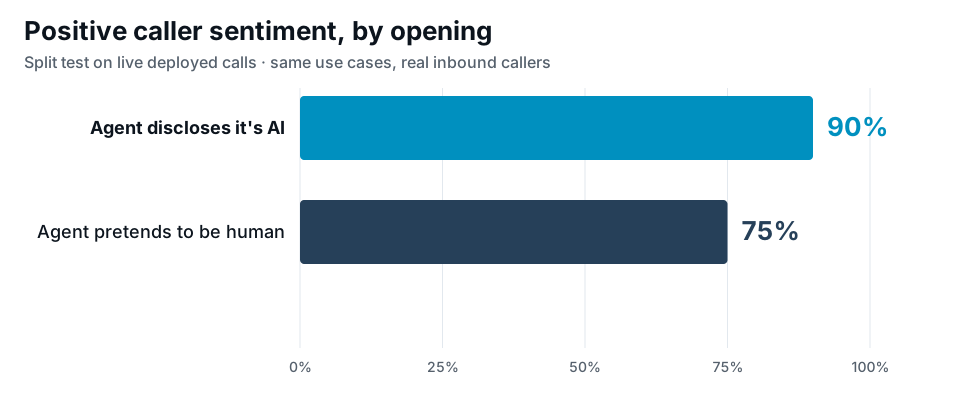
Not a rounding error. A 15-point gap, in the opposite direction from what the industry preaches.
Why Hiding It Backfires
The mechanism, once you hear enough calls, is obvious in hindsight.
A caller who is told up front they are talking to an AI recalibrates in about a second. They speak a little more directly, they get to the point, and the call proceeds. The disclosure costs you nothing because the caller was going to figure it out anyway.
That is the part the "pass as human" crowd misses. Callers do figure it out. A pause that lands slightly wrong, a phrase repeated once too precisely, and somewhere mid-call the caller realizes they have been talking to software that was pretending not to be. Now they are not evaluating your business. They are re-listening to the last ninety seconds wondering what else was fake.
The discomfort is not about AI. It is about being handled. Disclosure removes the deception, and with it the penalty.
What This Changes If You're Deploying Voice AI
Three practical takeaways from the data:
- Disclose in the first sentence. Not buried, not "powered by" fine print on a website. The agent says it plainly and moves on.
- Stop paying for indistinguishability. Tuning an agent to pass as human is effort spent making the eventual discovery worse. Spend it on the knowledge base instead, which is what callers actually judge.
- Regulation is moving toward mandatory disclosure anyway. Building disclosure-first now means the compliance conversation is already over for you. And since disclosure performs better, there is no trade-off to agonize over.
Every agent we deploy now opens with disclosure by default. It is baked into the framework, not decided per client.
The Bigger Pattern
The most useful finding here is not about disclosure. It is that the loudest assumptions in a young industry often have zero data behind them. "Callers hang up on robots" was repeated so often it became infrastructure, and it took one split test to knock it over.
If you are evaluating voice AI for your business and a vendor's pitch leans on how human their agent sounds, ask them a different question: what does your call data actually show?
Frequently asked questions
Do callers hang up when an AI receptionist says it's AI?
Not in our data. Across live deployed calls, agents that disclosed being AI up front produced 90% positive caller sentiment. Agents that pretended to be human produced 75%. Disclosure performed 15 points better, not worse.
Why does disclosing AI improve calls instead of hurting them?
Callers who are told up front relax and get to the point. Callers who work it out mid-conversation feel handled, and that discomfort shows up in how the rest of the call goes. The tell-tale pause or repeated phrase always gives it away eventually; disclosure just controls when.
Is an AI receptionist required to disclose that it's AI?
Rules vary by state and are moving, so build for disclosure rather than around it. But our data makes the legal question mostly moot: disclosure performs better anyway, so there is no upside in hiding it.
How was the 90% vs 75% split test run?
On our own deployed agents handling real inbound business calls: one variant opened by identifying itself as an AI assistant, the other did not. Post-call sentiment was scored across the full call, not just the opener.