Buying AI · 2026-08-07 · 4 min read
Vapi vs Retell vs Synthflow Is the Wrong Question
The internet is drowning in voice AI platform comparisons. After 400,000+ minutes of live calls on this stack, here is the uncomfortable truth: the platform is the smallest decision in the build.
TL;DR
- The platform comparison wars miss the point. Vapi, Retell, and Synthflow have converged to the point where platform choice rarely decides the outcome
- We say this with 400,000+ minutes of live calls on Retell as a certified partner, so it is not a hedge, it is field experience
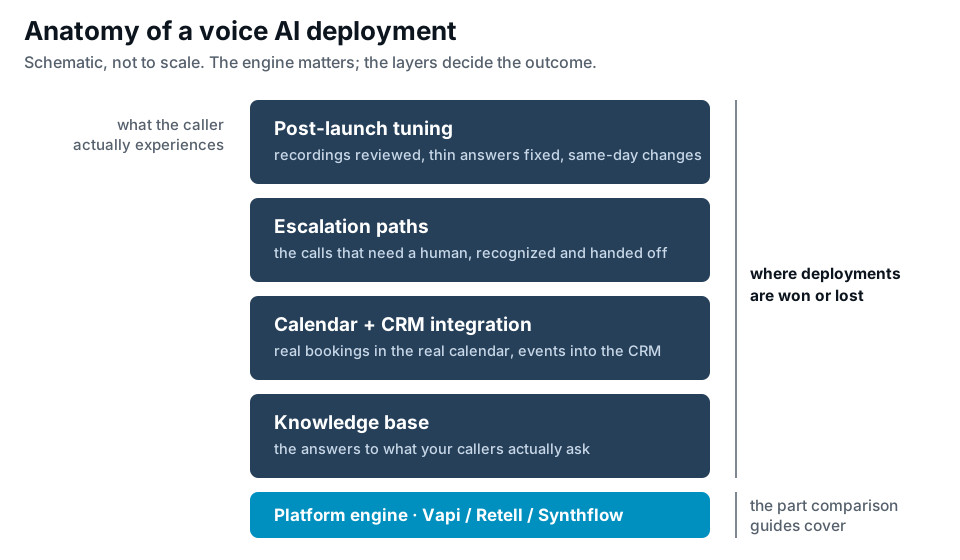
- Deployments live or die on the layer around the platform: knowledge base, calendar and CRM wiring, escalation paths, and post-launch tuning
- The vendor question that matters isn't "which platform." It's "let me hear your live agents, and show me how changes ship"
The Comparison Content Industrial Complex
Search any voice AI platform name this month and you will find a dozen fresh comparison guides, each testing the same platforms on the same criteria and reaching mildly different conclusions. Latency benchmarks. Voice quality scores. Pricing tables.
We read them too. But after two years of deploying agents for real businesses, over 400,000 minutes of live call time, and a certified partnership with one of the platforms being compared, here is the honest assessment: the platform is the smallest decision in the build.
That is not what a comparison guide can say, because the comparison is the product. It is, however, what the deployments show.
The Platforms Converged. The Deployments Didn't.
The leading platforms have spent two years competing on the same axes, and it worked. Sub-second responses and natural-sounding voices are now table stakes across the board. Picking among the top options gets you a capable engine either way.
And yet some deployments book consultations every day while others get quietly turned off after a month. The difference is never which engine is under the hood. In every failed deployment we have been called in to look at, the platform was fine and the build around it was missing:
- A knowledge base with actual depth. The agent could greet callers beautifully and then couldn't answer the third most common question the business gets.
- Booking wired to reality. "I'll have someone call you back" is not scheduling. If the agent cannot see the real calendar, handle the timezone edge cases, and write the appointment back into the CRM the business already uses, it is an answering machine with good diction.
- An escalation path. Some calls need a human. An agent that cannot recognize those and hand off gracefully turns your best calls into your worst ones.
- Anyone watching after launch. Agents are not install-and-forget. The businesses getting results review recordings, catch the thin answers, and ship fixes continuously. That is a process, and no platform sells it.
That layer is software and operations, not platform selection. It is also where all of our build time goes.
The Questions That Actually Predict Success
If you are evaluating vendors, skip the platform debate and ask these instead:
- "Let me hear recordings of your live agents on real calls." Not a demo reel. Real calls, with real callers. A vendor who cannot produce these is selling you their first attempt.
- "Walk me through how a booking lands in my calendar." The answer reveals whether they have solved integration or are hoping your use case is simple.
- "What happens when the agent doesn't know?" The graceful-failure answer separates builders from resellers.
- "I need a change on Tuesday. When does it ship?" Ours ship same day, because our agent flows are code rather than boxes on a canvas. Whatever the vendor's answer, get it in writing.
- "What do I get to see?" If the answer is a monthly summary rather than every call with its recording, you are being asked to trust a black box.
Notice that a platform name answers none of these.
Where the Platform Choice Does Matter
To be fair to the comparison guides: if you are a developer assembling your own stack, the platforms differ meaningfully in API depth and model control, and the guides cover that well. And pricing structures differ enough to matter at high call volumes.
But if you are a practice owner or service business evaluating vendors, you are not buying a platform. You are buying the deployment. Judge the builder, not the engine.
The Uncomfortable Summary
We are a Retell certified partner and we will keep building on Retell. If Retell disappeared tomorrow, we would rebuild the same deployments on another engine, and our clients would notice almost nothing, because everything they experience daily lives in the layer we built around it.
That is the real answer to "Vapi vs Retell vs Synthflow." Pick a good builder and the platform question mostly answers itself.
Frequently asked questions
Which voice AI platform is best, Vapi or Retell or Synthflow?
For most service businesses it is the wrong first question. The platforms have largely converged on latency and voice quality. Deployments succeed or fail on what gets built around the platform: the knowledge base, calendar and CRM integration, escalation paths, and whether anyone reviews the call recordings and tunes the agent after launch.
Why do voice AI deployments fail if the platform is fine?
Because a voice platform ships with none of the things a business actually runs on. No booking wired to your real calendar, no answer to the question your callers ask most, no path to a human when it matters, and no one watching the calls after week one. Those are all build decisions, not platform features.
What should I ask a voice AI vendor instead of which platform they use?
Ask to hear recordings of their live agents handling real calls. Ask how bookings land in your calendar, what happens when the agent doesn't know an answer, how fast a change ships after you request it, and whether you get visibility into every call. Platform names answer none of those.
Does OptiCommerceAI use Retell?
Yes, we are a Retell AI certified partner with over 400,000 minutes of live agent call time on the stack. And that experience is exactly why we tell prospects the platform choice matters less than the software and process built around it.